Every material has its own story
An exhibit consists of three parts, which we’ll cover in three blog posts. The first part consists of the aluminum frames. This blog post focuses on the second part: the so-called infills, or presentation materials. These are large panels that can be made from various materials. Each material has its own qualities and strengths.
Wood
The most traditional finishing material is wood. A thin wooden panel is attached to the aluminum frame with Velcro. This creates a wall with a uniform color.
Solid-color walls are primarily used as a blank canvas and for finishing touches. If a wall is taller than 2.5 meters, a panel is also attached to the back. This ensures that the neighboring booth also gets the neat look it deserves.
To add some variety to the solid color, we use stickers. These are easy to remove afterward, so the panels can be reused. It’s also possible to screw lightweight objects directly onto the panels, though this does make them less suitable for reuse.
Felt
One of the newer materials is felt. It’s often chosen as an eco-friendly alternative, but it has even more advantages. For example, you can use it to add texture to a wall, and it helps dampen sound.
With traditional materials, an exhibition wall is often two-dimensional. You can make text stand out, but you can’t add real texture. With felt, you can: stripes and even text can be incorporated into the material itself. This gives a flat presentation its own unique character.
In addition to its design possibilities, felt also has properties that set it apart from other materials. Due to its thickness, it absorbs sound and reduces reverberation in a room. This makes felt ideal for temporary meeting spaces at events. It’s also suitable for more everyday environments, such as offices and retail spaces.
Felt is therefore a durable material, but it does require extra care when cleaning, as it also absorbs liquids.
PVC
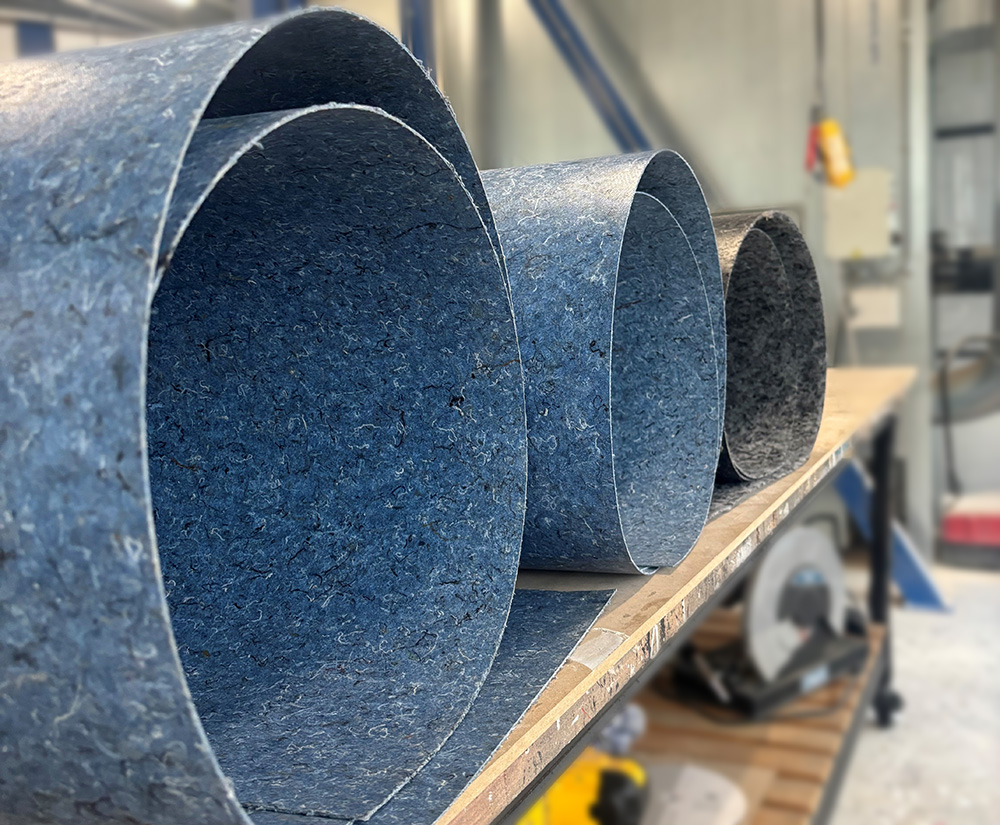
One material that absorbs less liquid is PVC. This, too, is a thin sheet that is attached to the wall with Velcro. PVC looks very similar to wooden infills, but there are definitely clear differences.
PVC sheet is significantly more flexible than wood. That is why it is primarily used for additional elements, such as a counter or a curved transition. PVC is therefore often combined with other materials, allowing it to closely follow the contours of the booth while still offering the strength of another material.
PVC is a good example of a recyclable material. By collecting the sheets, they can be recycled in large quantities. At the recycling center, old sheets are first washed, then ground up and melted down into new raw material. As a rule of thumb, PVC can be recycled 4 to 7 times. At Beaufair, we also place a strong emphasis on reuse.
PVC is therefore primarily used for finishing, to compensate for the limitations of other materials.
Conclusion
Every material has its own pros and cons. Which material is best for you depends on what matters most to you: reusability, budget, or recyclability. Often, a combination of these offers the best solution. Curious about what other materials we offer? Feel free to check out the Black-Frame website.